This page is intended to hold my notes for my end time (last days) Biblical study (including possible rapture dates). Why, you ask, do I need notes?
Over the past few years I've watched numerous YouTube channels talking about end times/rapture that use dates or make assumptions without fully explaining why they have made those assumptions or using a given date. They might have answered these questions in some videos they recorded years ago, but I'm not going to try watching 100's of hours of older videos hoping to find the answers. So this page is my attempt to list many of the common dates, ideas, and assumptions I've seen people use so that me, and others, won't need to go searching for answers to some of these questions.
Before I continue, I need to cover some important notes that are foundational to understanding the end times.
Notes:
Can we know the day or hour?
All people I've mentioned rapture to have responded with "We can't know the day or hour". This is a horrible mis-understanding of that scripture. If you want to see my response to this, go to Can't know the day or hour.
I need to mention John 10:10a (NKJV)"The thief comes only to steal and kill and destroy"
I mention the 2nd this since the enemy has done an (unfortunately) good job of stealing from us our history (when events have happened) since he knows that with good known dates for events we would be able to more accurately calculate when Jesus' second coming would be and he definitely does NOT want us to know that. This means that ALL of the dates shown below could be wrong (or right) so extend some grace knowing that the dates could be off a few years (or maybe not).
An example of what the enemy has stolen is seen in the Gregorian calendar.
The month of September is the 9th month, yet the root of the word is septem which means 7
The month of October is the 10th month yet the root of the word is octo which means 8
The month of December is the 12th month yet the root of the word is decem which means 10 From this it can be seen that the Gregorian calendar has been manipulated (to confuse people in my opinion). If December is the 10th month, then January should be the 11th month and February should be the 12th month. Ironically that would make March the 1st month which would much more closely match the Jewish calendar (described below).
Inclusive math. Unfortunately many use "exclusive" math instead of "inclusive" math (for details go to InclusiveMath) when performing data math which results in dates being 1 year to large.
If interested, check out GodCalledFestivals for a list of all current God called for festivals along with a couple of Jewish ones.
The Book of Revelation describes a 7 year period before Jesus' second coming. There are numerous views on this with
some believing that all events described in the book of Revelation have already happened
while others believe that some events have already happened with the second coming of Jesus yet to happen
while others, like myself, believe that these 7 years have not yet happened and are yet to be fulfilled. Since I believe in this view, everything below is why I believe in this view.
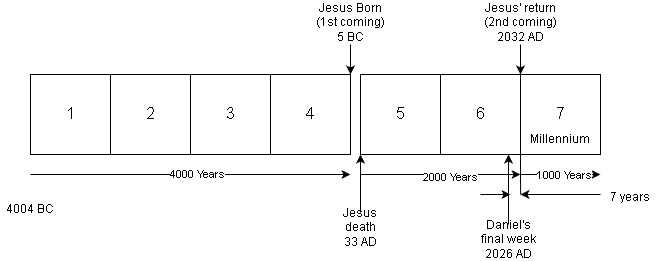
It is interesting that whether you look at the Hebrew year (5786) or the fact that Jesus came about 4000 years after creation and it has been about 2000 years after Jesus' crucifixion, both are very close to 6000 years. Since In Revelation we know that after Jesus returns, He will reign on Earth for 1000 years (Rev 20:4-6 (NIV)), that totals to 7000 years. Remembering, then, that 2 Peter 3:8 says "But you must not forget this one thing, dear friends: A day is like a thousand years to the Lord, and a thousand years is like a day." then that 7000 years would equate back to 7 days which takes us back to Genesis and the 7 days of creation.
The below graph illustrates this 7000 years:
This timeline assumes many different dates, all of which different people have different thoughts on:
Date of creation
Many people believe creation was year 4004 BC. I personally have picked 4004 BC since some 400+ year old bibles show 4004 BC as the date of creation which then means that 4000 years later Jesus was born which would be what you expect. See https://answersingenesis.org/bible-timeline/the-world-born-in-4004-bc/ as well. Other possible dates for creation are shown below, but all are based on when Adam was created and not on the date of creation itself. I mention them just to point out how wide a range different people's estimations are.
Jesus' Birth - numerous different thoughts on this
Oddly, the Gregorian calendar was supposed to be based on the birth of Christ, but the Gregorian calendar has no year 0. It starts with year 1. See "BC to AD transition" for a lot more details.
Scholars have estimated His birth sometime between 6 and 4 BC with some believing it to be 3-2 BC. https://www.gotquestions.org/what-year-was-Jesus-born.html believes His birth to be 5 BC and this is the year I personally like since it would be exactly 4000 years from creation (if creation is 4004 BC).
Many believe Jesus was born on December 25, but that would contradict Luke 2:8-9 that says that the shepherds were living out in the fields keeping watch over their flock by night which Jewish tradition says would be from spring until early October. The shepherds wouldn't have been out in their fields in December. I've seen some suggest that Jesus was conceived on Dec 25th and then born 9 months later in September. See https://www.christianity.com/wiki/jesus-christ/when-was-jesus-born.html.
Jesus' Crucifixion - numerous different thoughts on this. The general range is 30-33 AD.
Jesus' ministry most likely started when He turned 30 years old (Jewish tradition for priests) but there is nothing in scripture that says how old He was. Luke 3:23 does say "Jesus was about 30 years old when he began his special work for God..." but He could have been 31 or 32 years old (or older). If He was born 6-4 BC, then His ministry could have started 25-27 AD (if He was 30) or closer to 30 AD.
Some people lean towards Jesus' crucifixion being 30 AD since they like the fact that the temple was destroyed in 70 AD and 40 years earlier would be 30 AD for His crucifixion with this being yet one more example of God using the number 40 over and over again.
Historians looking at the Shroud of Turin, which many believe was Jesus' burial cloth, see coins placed on Jesus' eyes. Jewish tradition says that coins were placed on a dead person's eyes to help keep them closed during burial. Historians say that those coins have years of 29-31 AD (see https://drrichardkent.org/shroud-of-turin/the-coins-over-the-eyes-on-the-shroud/). Many people believe that only newly minted coins were used so believe His crucifixion to be no later than 31 AD. I'd say that the crucifixion is no earlier than 29 AD but could be after 31 AD (so still new coins, just never used before).
There are people who use Stellarium (https://stellarium-web.org/ a tool for looking at star/planet positions in the past or future) looking for a Jewish date of a new moon on Nisan 14 (Passover) since you need a new moon to have a solar eclipse which they believe is what is described in Luke 23:44-46 (NIV) which says "It was now about noon, and darkness came over the whole land until three in the afternoon, for the sun stopped shining." A problem is a solar eclipse has never lasted for 3 hours (the maximum time of totality ranges from 4-7 minutes not hours) so this is a problem with this view. So people trying to go back in time (using Stellarium) looking for a Passover date with a solar eclipse (many picking April 3, 33 AD) have problems (let alone the fact that there is no way to confirm that Stellarium shows good and accurate data). Unfortunately, if you are using a lunar calendar (see below), then Nisan 14/Passover would be a full moon so no way to have a solar eclipse. Note: there are some people who have created a lunar calendar with a full moon starting a month not a new moon (see MoonsStartingCalendar for alternative moon phases for the start of a new month).
I've picked His crucifixion to be 33 AD since numerous other people have decided on that date and it seems to be a good medium between the various thoughts.
Gap of 37 years
The gap of 37 years in my timeline represents the time Jesus was on Earth (5 BC to 33 AD). Many believe that the counting of the 6000 years has to be exact and cannot include the time Jesus was on Earth so the 1000 year time counting had to stop while He was on Earth and thus this gap.
Jesus' second coming
If Jesus was crucified in 33 AD, then 2000 years later would be 2032 AD (using inclusive math).
Since most believe that Jesus' 2nd coming has to happen at the end of Daniel's 70th (final) week (of years), then the beginning of the 70th week would have to be in 2026 AD (inclusive math so the 7 years would be: 26, 27, 28, 29, 30, 31, 32)
If He was crucified in another year, then you'd add 2000 to that and then subtract 7 years (inclusive) to find the start of the Tribulation (I use capital T tribulation since Jesus said in Acts 14:22 (NKJV) that we are already in (lower case) tribulation so the start of Daniel's final 7 years would be an increase in the tribulation seen). This means that crucifixion years cannot be earlier than 32 AD. For example, if He was crucified in 31 AD, then the end of Daniel's final 7 years would be 2031 and 7 years before that would be 2025 (inclusive) which has already passed. So His crucifixion could be 32 AD or later to fit this math.
An additional reason I believe that Daniel's final 7 years starts in 2026 (on the Gregorian calendar) is by looking at the jubilees (see Jubilee counting. If you start counting at 4004 BC (with 4003 BC being the 1st jubilee year), then 2025 AD would also be a jubilee year. But you'll say that that was last year, but I suggest that if we use the Jewish/static calendars (see below), then the new year (Nisan 1) would be closer to March 17 (static) or March 19 (Jewish) so "technically" we are still in the 2025th year. This means that as I write this on Feb 24, 2026 (on the Gregorian calendar) we are technically still in the 2025th year on the Jewish/static calendars and we won't move to the 2026th year until Nisan 1 (March 17-19, 2026 Gregorian).
Jesus' millennium reign/new heaven/new Jerusalem
this is where things are a bit less known since there has to be time for Satan to be released one last time for the final battle.
Some believe this happens at the end of the millennium reign so Jesus' reign is a little less than 1000 years so 1000 years would be both the millennium reign and final battle
Others believe that the final battle is after the millennium reign so the new heaven/new Jerusalem comes 7000 + X years where X=final battle
Purely Jewish/Hebrew view
Some might ask if there is anything other than when Jesus was crucified as evidence that the end is near. The answer is yes by looking at what Jewish year we are in. Purely from a Jewish perspective:
On Sept 22, 2025, the Jewish year became 5786
Some scholars suggest that the Jewish calendar is missing years meaning that the year 5786 is wrong. So some possible missing years are:
If 210 years is closer to being correct (which from my perspective more people believe), then the current year would be 5996 which means that in 7 years it would be 6002 (inclusive: 5996, 5997, 5998, 5999, 6000, 6001, 6002) which is very close to the above 7000 year graph and is very close to the 2032 AD Gregorian calendar time frame.
From a Rabbi
According to Rabbi Lawrence Hajioff (https://www.youtube.com/watch?v=uImVPV_zKU0) there are 28 times in Ecc 3 (NKJV).
Taking 6000 years (the max of Jewish time according to Rabbi Lawrence) and dividing this by 28 (times) you get that each time = 214.29 years. If you then take 6000 and subtract 1 time (of 214.29) you get 5785.71 which he suggests is the Jewish year the last time period would start.
If you round 5785.71 up, you get 5786 which happens to be the current Jewish year (happened on Sept 22-24, 2025 (Gregorian calendar)).
So from a Jewish perspective, if the end of time is 6000 years, then we are about to enter into the last of the times from Ecc 3:8 (NKJV) which is peace. Since we know from 1 Thessalonians 5:3 (NKJV) that in the last days people will be talking about "peace and safety", could it be that something significant will happen in the Jewish year 5786?
Calendars - which one to use?
All of the above has been talking years without looking at when a year actually starts, so let's drill down a bit looking at the yearly calendars that many people use.
When trying to overlay biblical events onto a Gregorian calendar (since that is the calendar that most of the world uses today) in an attempt to calculate possible rapture dates (or Jesus 2nd coming dates), we need to remember that there are several different biblical calendars that could be days to weeks different from one another when overlaid on top of a Gregorian calendar. The main difference is when does the new year start on a biblical calendar.
Some calendars:
only use the sun to calculate the beginning of the year
some use both the sun and the moon to calculate the start of a new year and
yet others don't use the sun but only use the date of the barley harvest and the moon.
Below I show the main biblical calendars I've seen used. Note, there are more calendars than those mentioned below, but it appears that most people are using one of the below.
Note: all biblical calendars do start with the month of Nisan.
Current Israel/Jewish calendar
This calendar has the following months: Nisan, Iyar, Sivan, Tammuz, Av, Elul, Tishrei, Cheshvan, Kislev, Tevet, Shevat, and Adar (and when a leap month is added it would be Adar II). See https://www.chabad.org/library/article_cdo/aid/2263459/jewish/Hebrew-Months.htm for more details.
This calendar is calculated based on the spring equinox (when the sun crosses the celestial equator). A very complicated mechanism is used and described in https://torahcalendar.com/ORBITS.asp. I've tried to figure this out for myself trying to calculate when Nisan 1 should be in various years and my calculations do occasionally work, but occasionally they don't so I'm missing something. https://www.hebcal.com/converter is a good place to go to map between Gregorian and Hebrew calendars.
Note: a major difference between the Gregorian calendar and the Jewish calendar is when a new day starts. On the Gregorian calendar, a new day starts at midnight while on the Jewish calendar, a new day starts at nightfall (in Jerusalem). See https://www.chabad.org/library/article_cdo/aid/526873/jewish/The-Jewish-Day.htm for more detail. This means that Jewish days are not exactly 24 hours. For example, after the Winter solstice, nightfall gets later and later meaning that a "day" will be a few minutes more than 24 hours while after the Summer solstice nightfall gets earlier and earlier meaning that a "day" will be a few minutes less than 24 hours.
A problem with this calendar is it is lunar based which means that Nisan 1 can vary by almost 30 days from year to year which means that Passover could be in March or April. The fact that Nisan 1 can change year to year is one of the reasons I personally do not believe this calendar should be used. See calendar table for examples. It would be like saying that in one year your birthday is on March 15 but the next year your birthday would be April 3. Yes I'm leaning on my own understanding on this, but I find it hard to imagine that God would use a calendar that can vary year to year.
See https://www.hoshanarabbah.org/pdfs/new_moons.pdf for some more details on this topic.
Other references:
The number of days in a Jewish month varies. Most months are a constant 29 or 30 days while 3 of the months could be different. See https://jewishroots.net/library/calendar-reference/chart-for-hebrew-months-and-gregorian-equivelants.html for more details.
This means that a year could be between 353 and 385 days in length depending on if a leap month has been added or not. In general, a non-leap month year will be 10-13 days off from the sun. To sync to the sun (365 days), a leap month gets added approximately every 3 years (in a 19-year cycle, leap months get added in years 3, 6, 8, 11, 14, 17, & 19)
Essene/dead sea/Enochian/Qumran calendar
While trying to understand this calendar, I found that different people's web sites claim that they were based on the Essene or dead sea calendar and other claim they are based on the book of Enoch which is the same as the Qumran calendar yet dead sea is exactly the same as Qumran so it is very confusing since a lot of overlap between them.
Just a couple of sites claiming to be Essene/dead sea/Enochian/Qumran with different start dates are:
https://www.luke810.com/essenecal.htm - This calendar uses the spring equinox (always March 20th on the Gregorian calendar) as the start of the year (Nisan 1)
https://dsscalendar.org/DSS-Greg.php?Y=2026 - This calendar is based on the dead sea scrolls and appears to start on March 18th which happens to be the day after the spring equilux (it might just be that Nisan 1 does actually start on March 17th in the evening but most of the day is on March 18th and why the calendar shows March 18th)..
Given these inconsistencies, I'm not recommending this.
Static calendar
Given all of the different views about the Essene/Enochian calendars, I've started to hear some people refer to the static calendar to distinguish it from the Essene/Enochian calendars. The Essene/Enochian calendars appear to start on the spring equinox while the static calendar starts a few days earlier on the spring equilux.
The static calendar uses the spring equilux which happens to always be on March 17th on the Gregorian calendar. A problem with any calendar that is lunar based, like the Jewish calendar, is the beginning of the year changes from year to year. See table that shows 8 years of data that shows how the Jewish calendar Nisan 1 can be on different days in March and April on the Gregorian calendar.
Since I've mentioned equilux, I want to also talk about equinox which people often get confused about. The equilux and the equinox are similar in that they are only 3 days apart, but they are different as shown below:
Equilux is the day of equal parts - the length of day and night (in Jerusalem) are equal and on the Gregorian calendar is always March 17th. Of these two, I believe this is one the Rabis were using since they can measure the length of a day and night to know when they are equil.
Equinox is when most people "think" the day and night are of equal length, but it is really when the Sun appears directly above the equator and is usually 3 days later and is always on March 20th. I find it hard to believe that Rabis would know when the Sun was directly over the equator since Jerusalem is not on the equator.
I personally like the static calendar (based on the Equilux) since Passover will always be on the same Gregorian date every year. It won't move and change.
How many days in an static month?
The static calendar is based on the equilux/enoch calendar where the number of days per month would be: 30, 30, 31, 30, 30, 31, 30, 30, 31, 30, 30, 31
So there are 8 months with 30 days and 4 months with 31 days for a total of 364 days (what happens with the last 1.25 days varies)
Note: Some people dismiss this calendar since they insist that the day Jesus was crucified (Passover) had to be a full moon (and a lunar eclipse at that) and since this calendar doesn't use the moon, then this calendar makes no sense to them.
I personally disagree and I like the static calendar since dates are always the same. This means that if Nisan 1 is always March 17th (on the Gregorian calendar), then Passover would be 14 days later on Nisan 14 and would always be March 30th regardless of the year. Since God is the same yesterday, today, and forever, I'd expect that the God called for feast days to fall on the same day every year (relative to where the Earth is compared to the sun). Yes Passover does fall on the same Jewish calendar day (Nisan 14), but since Nisan 14 on the Jewish calendar can fall on the Gregorian calendar in March to April, to me that means that Passover is not the same yesterday, today and forever since it moves and again why I'm preferring the static calendar.
Abib Barley calendar
This calendar is not based on the sun but is:
based on the moon AND
on when the barley is near harvest.
My understanding is that this calendar's beginning of the new year (Nisan 1) begins on the first sliver moon seen after "abib barley" which is
the barley is brittle enough to be damaged by bad weather, lightening in color, and contains enough dry material to be eaten when lightly roasted. Yet, it's still about two or three weeks from harvest.
as defined at https://lousantini.substack.com/p/happy-new-year-wait-what An additional reference I found to this calendar is https://www.hoshanarabbah.org/pdfs/cal_demyst.pdf
I personally do not like this calendar since it is dependent on a person seeing the state of the barley harvest and then using the moon to calculate when Nisan 1 is. This means you can never calculate future dates for Passover which makes looking for future dates impossible.
#CalendarTable
Table mapping the above calendars to the Gregorian calendar
In calendar table, Nisan 1 on the Gregorian calendar is shown for 2 of the above calendars (Jewish and static).
When could the rapture happen?
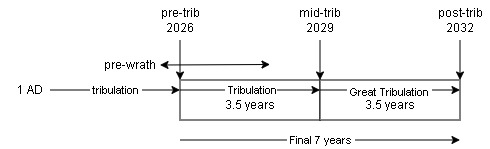
There are 5 main views on when the rapture could happen. The following graph shows them.
Note, this assumes that creation is 4004 BC and Jesus' birth/crucifixion being around 5 BC and 33 AD, then Jesus' 2nd coming could be 2032 AD with the 7 year Tribulation period being 2026-2032.
If you are pre-trib, then the rapture could happen at any time but before 2027.
If you are mid-trib, then the rapture could happen in 2029
If you are post-trib, then the rapture could happen in 2032
If you are pre-wrath, this is more complicated but the rapture could happen 2026-2029
Some people believe that there is no rapture at all
Miscellaneous topics
Problems pure lunar calendars
Calendars that use the moon to calculate the start of a month have problems since the Bible says that the Sabbath has to occur every 7 days and since the moon's revolution about the Earth (relative to the Sun) is 29.5 days, then a month is not a multiple of 7 so you end up with extra days that have to be accounted for. See pure lunar calendar for more details.
What year did Israel enter the promised land?
One source says that Israel's crossing of the Jordan into the Promised Land was in 1406-1407 BC. See here for more details.
Jubilees
The bible says that every 50 years is a jubilee. If you go to jubilees, you can see all of the jubilees from creation to now. It is very interesting to look at all of the jubilee years since Israel first went into the promised land in what would have been a jubilee year (1406 BC). In my opinion, there is an increased likelihood of the rapture also happening during a jubilee year and it is very interesting that 2025 is a jubilee year. See above for more details.
Some things to ponder about the Tribulation (final 7 years)
asteroid Apophis (April 13, 2029)
NASA says that asteroid Apophis will make its closest approach to Earth on April 13, 2029, passing closer than the distance of many satellites in geosynchronous orbit. Some have wondered if this asteroid won't actually hit the Earth instead and if so could it be "Wormwood" described in the 3rd trumpet in (NKJV)
The 14,400 witnesses
There is no indication in the bible on when the 14,400 witnesses show up and when they leave, though if when they are first mentioned is important, then they are first mentioned between the 6th and 7th seal and if you assume that the seal judgements happen in the first 3.5 years, then it is possible they show up at or near the beginning of the final 7 years. As for what happens to them, (NKJV) says that the 14,400 witnesses are standing with Jesus on Mt. Zion. Now this could mean:
they are still alive when Jesus returns or
they get killed and are brought back with Jesus at His 2nd coming
The two witnesses
There is no indication in the bible on when the two witnesses show up, though if when they are first mentioned is important, then they are first mentioned between the 6th and 7th trumpets and assuming that the trumpet judgements happen around the middle (or later) of the final 7 years, then the two witnesses could show up at the mid-point and go to the end of the final 7 years. We do, though, know how long they are here on Earth which is 1260 days (3.5 years) as shown in Rev 11:3 (NKJV). so the latest they can show up is at the mid-point since they can't be here after Jesus' second coming.
Since the anti-christ sits on the throne in the rebuilt temple in Jerusalem at the mid-point (3.5 years) claiming to be the messiah, the two witnesses could be God's response to this since they show up and stay in Jerusalem. And right at the very end before Jesus comes, the anti-christ/satan kills the two witnesses believing he has won until a few days later Jesus does return.
Does the rapture happen in a twinkling of an eye?
I believe that the rapture takes some time to happen and does not happen in a twinkling of an eye. People reference 1 Corinthians 15:51-52 (NKJV) as their proof-text. Now clearly these verses do say we will be changed in a twinkling of an eye, but I do not believe that being changed is the same as raptured. There are a handful of biblical examples of raptures and none of them happen quickly. All happen somewhat slowly. To see my full explanation, see slow rapture for a lot more details.
Why does the Jewish calendar year start in September while the year actually begins in March?
 "The thief comes only to steal and kill and destroy"
  This timeline assumes many different dates, all of which different people have different thoughts on: